Depiction of AI in Science Fiction
Lately I’ve been reading a lot about AI, mixed with some science fiction (also about AI). Some of it has depictions or guesses on how we might use AI. Some have it as any standard interaction with a computer, where the idea of an OS or typing into something to get a message is no longer an option, we must interact with an AI program that will ration our speech through NLP and turn it into commands that any computer would do. Others depict no difference than humans, as another race of beings with equal judgments and interactions these are less interesting.
Red Mars

Red Mars, published in 1992, is a book about 100 astronauts going to Mars to start the colonization process. Kim Stanley Robinson invites us to theorize every little detail of how this is accomplished, how the selection processes should go, and what policies and religion we should introduce to Mars. And, as we see in its sequels, Green and Blue Mars, terraforming and war (sometimes one and the same).
AI in the Mars series is used as an interface with large sets of data to parse it into human-readable format, very similar to our use case today, but hopefully with more success.
He called up Sax, and asked if he could connect his AI into the UNOMA emigration and planetary travel records, without alerting UNOMA to the connection. After some investigation Sax got back to him and said that he could manage that, and so John sent a sequence of questions through, and then continued to fly. An hour and many craters later, Pauline's redlight blinked rapidly, indicating a downloading of raw data. John asked the AI to run the data through various analyses, and when she was done he studied the results on the screen. Patterns of movement; they were confusing, but he hoped that when matched with the sabotage incidents, something might turn up.
There isn’t a clear indication of what interface John is using here, whether it’s typing on a screen or audibly asking his AI to research the data. Other examples include translating language, alerting someone when some data reaches a preset threshold, automatic decryption, and any general computing.
Ann was still not talking, and they did not ask her to drive. Sax drove with one eye on his AI screen, which was giving him atmospheric readouts. She could tell from across the car that the AI was indicating that the impact of Phobos was thickening the atmosphere a great deal, projected to as much a fifty millibar addition, an extraordinary amount.
There is also the concept that people have their own personal AI, or a specific ship can have a built-in one. This is similar again to running our own models that will have access to our own messages and data. It’s not a new idea. Kim Stanley Robinson gets it close to how we may see ourselves using AI today, for very specific tasks that may replace computers in general. There is no concept of hallucinations or interpreting data incorrectly, as AI does now. But from 1992, it is impressive how this may seem.
Anathem
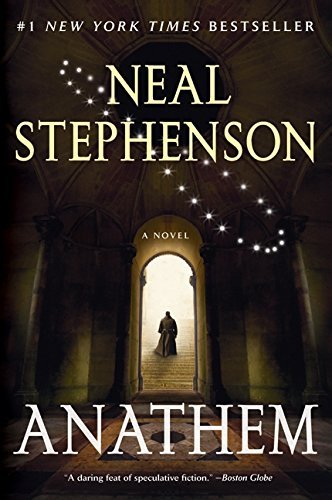
Anathem, from 2008, is a wild book. Written by Neal Stephenson, who, in Cryptonomicon, predicted cryptocurrencies, netbooks, and encrypted emacs. I include it here to contrast what even a computer may look like in a science fiction world. Referred to as “syndevs,” the main character does not care or know how to interface with a computer, relying on internal knowledge, and only interfacing with tablets, jeejaws, or syndevs when the required thinking is computational in nature. As such, concepts like content filtering or the opposite are completely foreign to them.
So crap filtering became important. Businesses were built around it. Some of those businesses came up with a clever plan to make more money: they poisoned the well. They began to put crap on the Reticulum deliberately, forcing people to use their products to filter that crap back out. They created syndevs whose sole purpose was to spew crap into the Reticulum. But it had to be good crap.
Two years after the creation of Twitter and one year after the launch of the iPhone, we were already aware that an abundance of content can cause problems and create entire cottage industries around it: both polluting and filtering. Other uses of syndev we can simplify into a computer as well; the glossary does this.
Syndev: Contraction of Syntactic Device. A computer.
Syntactic Device: In Earth terms, a computer.
A Borrowed Man
A more recent book, from 2015, written by Gene Wolfe at 84 years old, was the last book published before his death in 2019. (There have been some posthumous publications since then, including the sequel to A Borrowed Man, Interlibrary Loan.) His age may show in some aspects of this writing, hilariously by calling anything computer-like or a device with a screen “a screen” and anyone who is skilled with such devices “good at screens,” but also in the story itself of a man brought to life outside his time period. Not suddenly, but due to the fact that he is a clone of an old writer, he cannot learn any new skills or history and is forced into the confines of an interactive library.
Gene Wolfe thought about the relationship between language, memory, and identity. In Book of the New Sun, there is a race of people who only communicate through pre-scripted propaganda messages, however they have developed a way to expand their language, and even tell stories using only their pre-set sentences. In A Borrowed Man, the main character E. A. Smithe is a clone of a man using only previous publications, he speaks and reasons about things as much as the original author, it’s seemingly perfect at first until we learn of a book he authored that was left out of the training set. This causes him to make guesses or hallucinations about what the contents and meaning could be, realizing he is an imperfect clone and clearly cannot think like the original author.
Further Reading
- A Weird Mystery: James Wynn considers Gene Wolfe’s ‘A Borrowed Man’
- Any of the books mentioned or linked